Music Publishing 101: How Songwriters Get Paid
Author: UDMV Charlie
Publisher: UDMV Editorial Staff
Date Published : Aug 11,2026
Learn how music publishing works, who owns your songs, how publishing royalties are generated, and how independent artists and songwriters get paid.
. TABLE OF CONTENTS
- What Is Music Publishing?
- The Two Copyrights Behind a Song
- What Does a Music Publisher Actually Own?
- How Music Publishing Makes Money
- Performance Royalties
- Mechanical Royalties
- Synchronization Licensing
- Songwriter Share vs. Publisher Share
- Who Collects Music Publishing Royalties?
- PROs vs. The MLC vs. Distributors
- Do Independent Artists Need a Publisher?
- What Is Publishing Administration?
- What Happens When Multiple People Write a Song?
- Music Publishing Example
- Common Music Publishing Mistakes
- Independent Artist Publishing Checklist
- Frequently Asked Questions
You wrote a song.
You recorded it.
You uploaded it to streaming platforms.
Then the streams started coming in.
You might assume your distributor will simply collect all the money the song generates.
Unfortunately, music royalties don't work that way.
A single song can generate money through multiple copyrights, royalty systems and collection organizations. If those rights aren't properly registered and administered, some of the money generated by your music may never reach you.
That's where music publishing comes in.
Understanding publishing is one of the most important business skills an independent artist, producer or songwriter can learn.
What Is Music Publishing?
Music publishing is the business of managing, licensing and generating income from the copyright in a musical composition.
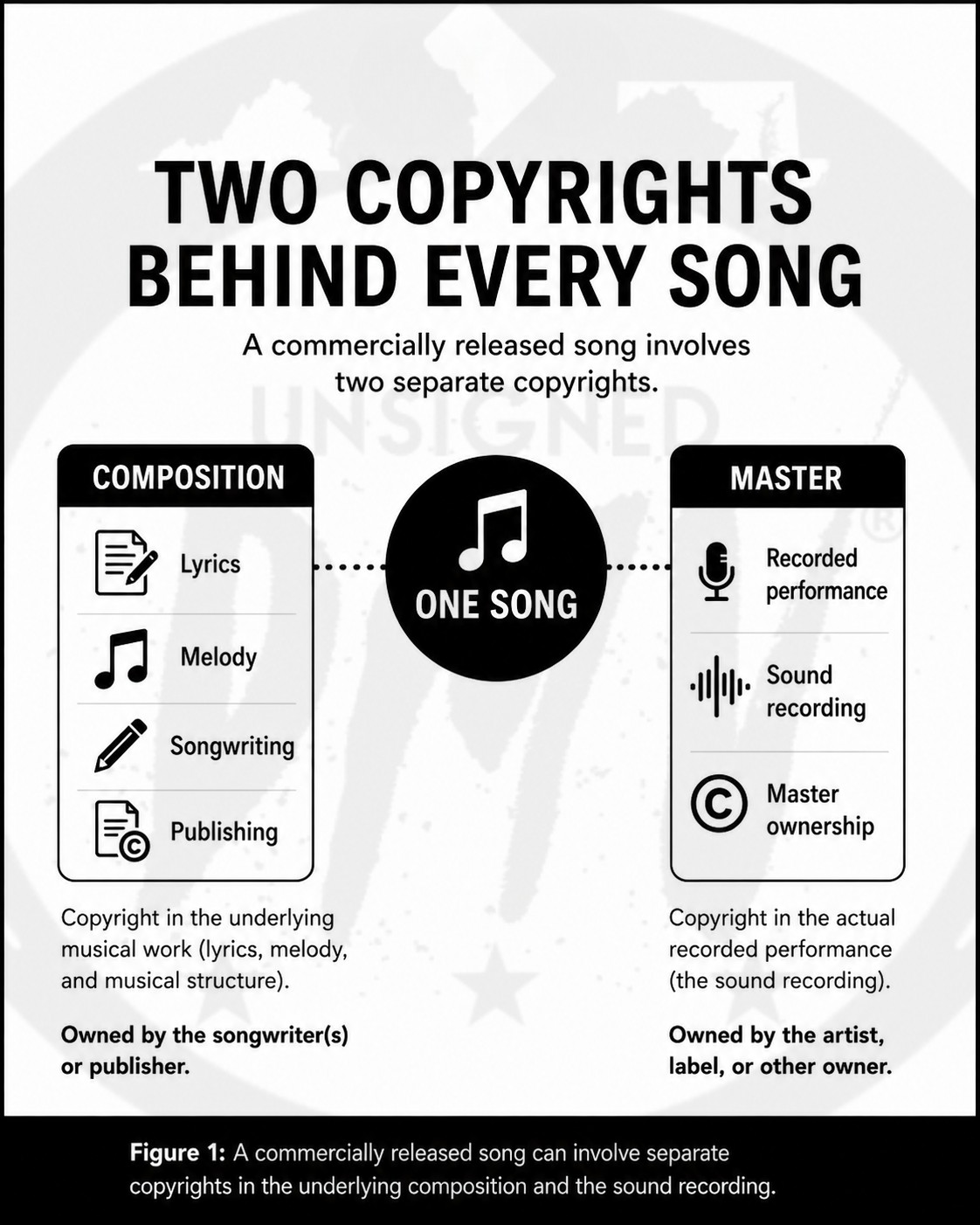
The composition is the underlying song — generally including elements such as the lyrics, melody and musical structure — rather than one particular recording of that song.
The U.S. Copyright Office makes an important distinction between a musical composition and a sound recording. They are separate copyrighted works.
This distinction sits at the center of the music business.
Think about it this way:
The song = composition
The recorded performance of the song = sound recording/master
That means one piece of music can involve two separate copyrights.
The Two Copyrights Behind a Song
Imagine an artist named DMV Artist A writes a song called Started From the District.
The lyrics and melody represent the:
Copyright #1 — Musical Composition
This copyright belongs initially to the songwriter or songwriters who created the composition, subject to contracts, work-for-hire arrangements, transfers and other circumstances.
Then DMV Artist A goes into the studio and records the song.
That particular recorded performance creates another copyright:
Copyright #2 — Sound Recording
This is commonly called the master.
The Copyright Office specifically explains that copyright in a sound recording is different from copyright in the underlying musical composition.
So:
Composition
Lyrics + melody + underlying song
versus
Master
The actual recorded version listeners hear.
This distinction becomes extremely important when money starts flowing.
Why This Matters for Independent Artists
Major-label artists often have different companies handling different rights.
An independent artist may control several of them.
You could potentially be:
Artist → Master Owner
and
Songwriter → Composition Owner
and
Publisher → Publishing Rights Controller
One song can therefore create multiple revenue streams for the same person.
But those revenue streams don't necessarily arrive through the same company.
That is where many independent artists become confused.
What Does a Music Publisher Actually Do?
A music publisher works with the composition, not simply the recording.
Publishing can involve:
- registering compositions
- administering copyrights
- collecting royalties
- issuing licenses
- managing song ownership information
- monitoring royalty sources
- helping exploit compositions commercially
- pursuing synchronization opportunities
- working with collection societies
CD Baby describes a music publisher as the owner or administrator of the song copyright rather than the sound recording.
Traditional publishing companies may also provide creative services.
For example, publishers can connect songwriters with:
- recording artists
- producers
- other songwriters
- film and television opportunities
- advertising opportunities
- music supervisors
But publishing doesn't automatically mean signing your songs away.
There are several publishing arrangements, including traditional publishing deals, co-publishing agreements and administration agreements.
We'll break those down later in this Music Publishing series.
How Does Music Publishing Make Money?
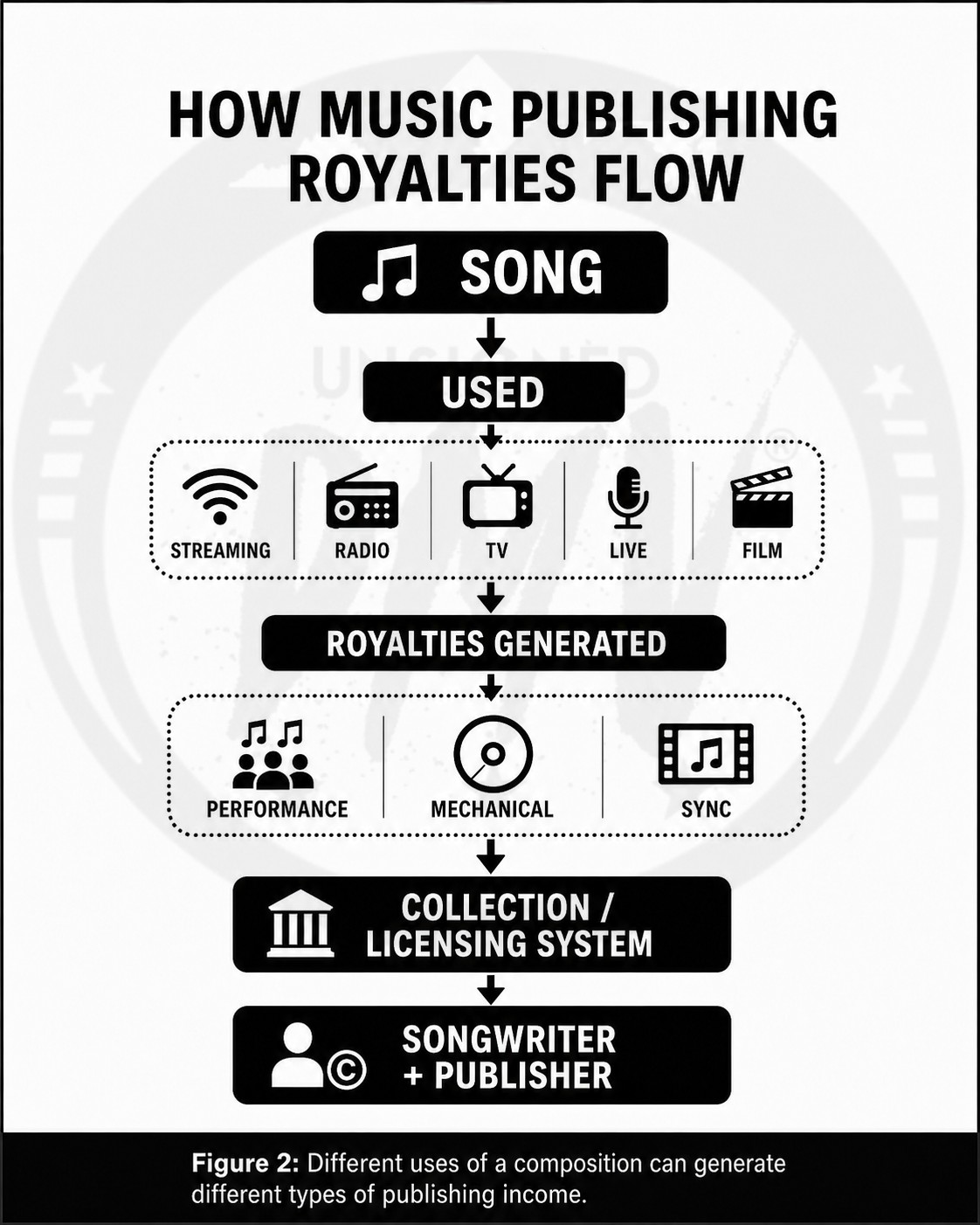
A composition can generate publishing income when it is used.
Some of the most important categories include:
Performance royalties
Mechanical royalties
Synchronization income
There are additional rights and revenue categories in the larger music-rights ecosystem, but these three concepts are essential for beginners to understand.
1. Performance Royalties
Performance royalties can be generated when compositions are publicly performed or transmitted through qualifying uses.
Examples can include:
- radio
- television
- live venues
- concerts
- certain streaming activity
- businesses playing music
- other licensed public performances
In the United States, songwriters commonly encounter Performing Rights Organizations, or PROs, such as ASCAP, BMI and SESAC.
PROs help license public performances and distribute applicable performance royalties.
This is one reason joining a PRO can be an important step for a songwriter.
But there's an important misconception:
Joining a PRO does not automatically mean every type of publishing royalty is being collected for you.
Performance royalties represent only part of the publishing ecosystem.
2. Mechanical Royalties
Mechanical royalties are associated with the reproduction and distribution of musical compositions.
Historically, that included things such as physical records.
Today, mechanical royalties are also important in digital music.
Interactive streaming can generate mechanical royalties for compositions.
In the United States, The MLC administers blanket mechanical licensing and collects eligible U.S. digital audio mechanical royalties from covered digital services before distributing matched royalties to rightsholders.
The organization says self-administered songwriters, composers, lyricists, publishers and administrators can receive qualifying royalties after usage data is matched.
Joining The MLC as an eligible member is free.
This creates an important lesson:
Your PRO and The MLC don't perform exactly the same job.
We'll dedicate a separate article to this distinction.
3. Synchronization Licensing
Have you ever heard a song playing during:
- a movie
- TV show
- commercial
- video game
- trailer
- online advertisement
?
That may involve synchronization licensing, commonly called sync.
Sync occurs when music is synchronized with visual media.
For an original commercial recording, a production commonly needs permission involving both sides of the music:
Composition → synchronization license
Master recording → master-use permission/license
If you control both your publishing and master, you may be able to authorize both sides yourself, depending on any agreements covering the music.
This can make independent music attractive in certain licensing situations because clearing the necessary rights may be simpler.
Songwriter Share vs. Publisher Share
One concept beginners frequently encounter is the distinction between the:
writer's share
and
publisher's share
of performance income.
The songwriter side belongs to the writer.
The publishing side relates to the publishing interest in the composition.
For an independent songwriter who hasn't transferred those publishing rights, that songwriter may effectively function as their own publisher.
CD Baby explains that if a songwriter hasn't signed a publishing deal, they are generally considered their own publisher.
This is extremely important.
Being "unsigned" doesn't mean you have no publishing.
You may actually own it yourself.
Who Collects Music Publishing Royalties?
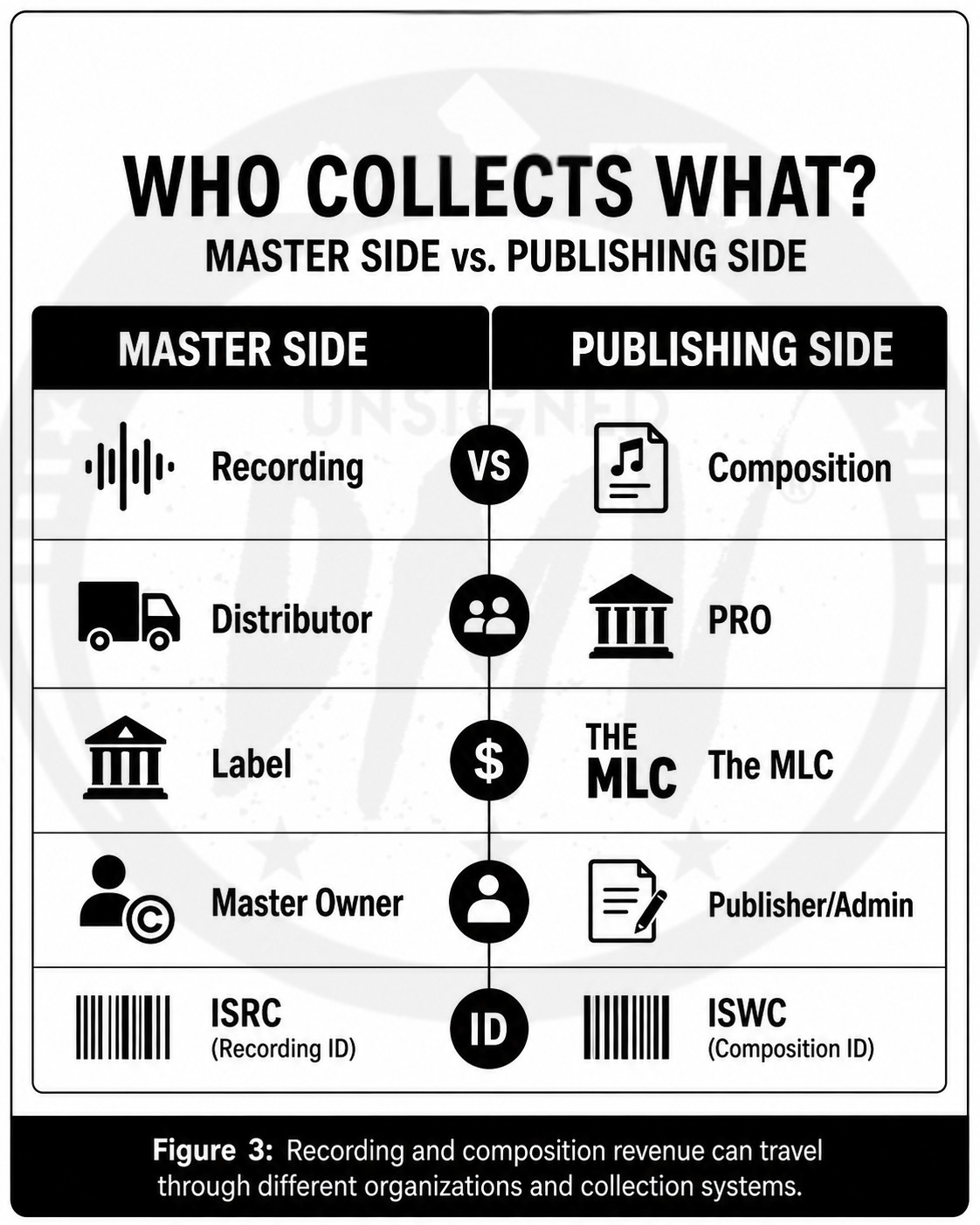
There isn't one universal company that handles every music royalty.
Instead, different organizations perform different jobs.
A simplified U.S.-focused framework looks like this:
| Organization | Primary Role |
|---|---|
| PRO | Performance-right licensing/royalty collection |
| The MLC | Certain U.S. digital mechanical royalties |
| Publisher | Manages/exploits composition rights |
| Publishing Administrator | Registers works and administers/collects publishing royalties |
| Distributor | Delivers recordings to DSPs and generally accounts for recording-side revenue under its agreement |
| Record Label | Commonly manages/exploits master recordings |
| SoundExchange | Certain U.S. digital performance royalties associated with sound recordings |
The exact royalty flow depends on territory, usage type, contracts and ownership.
PRO vs. Distributor: They Are Not the Same
This is one of the biggest mistakes new artists make.
Imagine you distribute your single through a digital distributor.
The distributor sends the recording to services such as Spotify and Apple Music.
When that recording generates revenue, your distributor generally accounts to you for recording-side earnings according to your distribution agreement.
But that does not necessarily mean your distributor is collecting every royalty generated by the composition.
Remember:
Distributor
Primarily concerned with your recording/master distribution.
Publishing system
Concerned with the underlying composition.
An independent artist who writes and records their own music may therefore have money moving through both sides.
PRO vs. The MLC
This distinction deserves special attention.
PRO
Think:
PUBLIC PERFORMANCE
The MLC
Think:
U.S. DIGITAL AUDIO MECHANICALS under the blanket license it administers
The MLC explains that mechanical royalties from interactive on-demand streaming are calculated differently from simple physical/download mechanical rates because multiple factors affect those streaming royalties.
Therefore:
PRO ≠ The MLC
And:
The MLC ≠ your distributor
Each exists within a different part of the music-rights ecosystem.
Do Independent Artists Need a Music Publisher?
Not necessarily.
If you wrote a composition and haven't transferred your publishing rights, you may already control the publishing.
The more useful question is:
Who is administering your publishing?
Owning rights and properly administering them are different things.
You could own 100% of your publishing while doing a poor job of registering songs, tracking royalties and maintaining metadata.
That's where publishing administration becomes important.
What Is Publishing Administration?
A publishing administrator handles administrative responsibilities associated with your compositions.
That can include:
- registering songs
- maintaining ownership information
- registering works with collection societies
- collecting royalties
- monitoring your catalog
- managing rights information
A publishing administrator does not necessarily need to own your copyright.
For example, Songtrust describes publishing administration as managing registrations, licensing and royalty collection while allowing the copyright holder to retain ownership.
This creates an important distinction:
Traditional Publisher
May acquire/control an ownership interest depending on the deal and can provide both administrative and creative services.
Publishing Administrator
Typically administers rights without acquiring ownership of the copyright, according to the specific agreement.
Administration companies usually earn money through fees or commissions.
Never assume the terms are identical between companies.
Read the agreement.
What Happens When Multiple People Write a Song?
Suppose four people contribute to a record:
Artist A — lyrics
Artist B — hook
Producer A — music
Producer B — additional composition
You need to determine who actually contributed copyrightable authorship to the composition and agree on the ownership percentages.
This is where song splits become critical.
For example:
| Contributor | Publishing Split |
|---|---|
| Artist A | 40% |
| Artist B | 20% |
| Producer A | 30% |
| Producer B | 10% |
| TOTAL | 100% |
Those percentages should be agreed upon and documented as early as possible.
A split sheet can document information such as:
- legal names
- songwriter names
- ownership percentages
- PRO affiliations
- publisher information
- contact information
- signatures
Don't wait until the song goes viral to decide who owns it.
Disputes become much more expensive once money is involved.
A Simple Music Publishing Example
Let's follow one independent artist.
Meet:
DMV Artist A
They write 100% of a song called:
"Capital Dreams."
They also pay for and own the finished master.
They therefore potentially control:
Composition
100%
Master
100%
Now imagine Capital Dreams generates:
1,000,000 interactive streams.
Those streams can implicate revenue associated with the master recording and royalties associated with the underlying composition.
The money does not simply travel through one pipe.
A simplified model looks like:
STREAM
↓
MASTER SIDE
DSP
↓
Distributor / Label arrangement
↓
Master owner
COMPOSITION SIDE
DSP / licensing ecosystem
↓
Performance + mechanical royalty systems
↓
Songwriter / Publisher / Administrator
The exact calculations and payment routes are more complicated, but this framework is what independent artists should understand first.
One stream can touch more than one music right.
The "Royalty Pipes" Concept
Here's an easier way to remember publishing.
Imagine your song creates several pipes carrying money.
Pipe #1
Master recording revenue
Pipe #2
Performance royalties
Pipe #3
Mechanical royalties
Pipe #4
Synchronization income
Pipe #5
Other applicable licensing and royalty income
If you only connect one pipe, you shouldn't assume the others automatically redirect themselves into your bank account.
Publishing administration is largely about making sure your composition is correctly identified, registered and connected to the systems responsible for paying its rightsholders.
Metadata Matters More Than Artists Think
Your song isn't identified only by its title.
Rights systems rely heavily on metadata.
Important information can include:
- songwriter legal names
- stage names
- ownership percentages
- publisher information
- PRO affiliations
- song titles
- alternate titles
- ISWC
- ISRC
- recording information
Incorrect metadata can contribute to matching and royalty problems.
This is why publishing should be handled before or around release, rather than becoming an afterthought months later.
ISRC vs. ISWC
Artists frequently confuse these identifiers.
ISRC
International Standard Recording Code
Think:
RECORDING
It identifies a particular sound recording.
ISWC
International Standard Musical Work Code
Think:
COMPOSITION
It identifies a musical work.
A remix, live recording or alternate recording could potentially have its own recording identifier while still involving the same underlying composition.
Remember:
ISRC = recording.
ISWC = composition.
Common Music Publishing Mistakes Independent Artists Make
1. Thinking distribution equals publishing
Getting a song onto Spotify doesn't automatically solve your entire publishing situation.
2. Not registering compositions
Creating a song and properly administering its royalty collection are separate tasks.
3. Ignoring mechanical royalties
Some songwriters understand PROs but don't understand mechanical royalty collection.
4. Not documenting splits
"Everybody knows the split" isn't good rights management.
Write it down.
5. Confusing the master with publishing
Owning the recording doesn't automatically mean you own the entire composition.
6. Registering conflicting ownership information
If one songwriter says the split is 50/50 while another submits 70/30, problems can follow.
7. Waiting until the song becomes successful
Publishing should be part of the release process.
Not the emergency process.
Independent Artist Publishing Checklist
Before releasing an original song, determine:
□ Who wrote the lyrics?
□ Who wrote the melody/music?
□ Did the producer contribute to the composition?
□ Are all songwriting splits agreed upon?
□ Is there a signed split sheet?
□ Who owns the composition?
□ Who owns the master?
□ Are the songwriters properly affiliated with the appropriate rights organizations?
□ Is the composition properly registered?
□ Is U.S. digital mechanical collection being handled where applicable?
□ Who is administering the publishing?
□ Is your metadata consistent?
□ Do you understand which royalties your distributor collects?
□ Do you understand which royalties it doesn't collect?
If you can't answer those questions, your release probably isn't finished from a business standpoint.
The Most Important Lesson About Music Publishing
You don't need to become a copyright attorney to understand publishing.
Start with one principle:
The song and the recording are two different assets.
From there, understand who owns each asset and which organizations collect money generated by each.
For independent artists, this knowledge can be especially powerful.
If you write your songs, own your masters and retain your publishing, you're not simply creating music.
You're building a catalog of intellectual property.
And that catalog can potentially generate income for years.
PEOPLE ALSO ASK
What is music publishing in simple terms?
Music publishing is the business of managing and monetizing the copyright in a song's underlying composition. It includes activities such as registering songs, licensing compositions and collecting publishing royalties.
Do I own my publishing if I wrote the song?
Generally, the songwriter initially owns copyright in their original contribution unless ownership is affected by an agreement, employment/work-for-hire situation or subsequent transfer. If you haven't assigned your publishing rights to someone else, you may control your publishing.
Is a distributor a music publisher?
Not necessarily. Distribution primarily concerns getting sound recordings onto music services and accounting for recording revenue under the distribution agreement. Publishing concerns the underlying musical composition.
Do producers get publishing?
A producer can have songwriting ownership when the producer contributes copyrightable authorship to the musical composition. The appropriate percentage depends on the actual contribution and agreement among the parties.
What is the difference between a master and publishing?
The master is the copyright associated with a particular sound recording. Publishing concerns rights associated with the underlying musical composition. The Copyright Office recognizes them as separate copyrighted works.— U.S. Copyright Office
FREQUENTLY ASKED QUESTIONS
Do independent artists need music publishing?
Independent songwriters already have publishing rights in compositions they own. What they need to determine is how those rights will be administered, licensed and monetized.
Can I be my own music publisher?
Yes. An independent songwriter who retains their publishing can function as their own publisher.
Does Spotify pay publishing royalties?
Interactive streaming involves both recording and composition rights, and composition-side royalties can include performance and mechanical components. The payment and collection routes differ depending on the royalty and territory.
Does my PRO collect mechanical royalties?
A U.S. PRO's core role concerns performance rights. U.S. digital audio mechanical royalties under the blanket license administered by The MLC are handled through The MLC rather than simply being your PRO performance payment.
What happens if I don't register my songs?
Copyright ownership and royalty administration are different issues. Poor or missing registrations can make it harder for collection systems to identify the proper rightsholder and deliver royalties.
What's the difference between a publisher and publishing administrator?
A publisher may own or control publishing rights and may provide creative services. An administrator primarily handles rights administration and royalty collection without necessarily acquiring copyright ownership.
Independent Artist Music Publishing Checklist
15 Things Every Songwriter Should Check Before Releasing a Song
Before you release your next record, make sure your publishing is handled.
Download the free Unsigned DMV Music Publishing Checklist and walk through the business side of your release step-by-step.