7. Album and Song Reviews
In a world where you can stream millions of songs at the tap of a button, there’s more of a need than ever for quality music reviews.
A good review can help you sort through the deluge of new and existing music, saving you the time you would otherwise have to spend listening to entire albums just to find the couple tracks you like.
When writing a review, you need to keep three things in mind:
- Be as objective as possible (while acknowledging any biases you have).
- Use some sort of numerical ranking system (scale of 1-5 or A-F, for example).
- Answer the reader’s main question: “Would I like listening to this?”
There’s plenty of room for clever wordplay and fancy musical terminology, but the best reviews use those to complement a piece that meets the three above criteria.
Ultimately, the person reading your review cares less about your beautiful prose and more about how you can help them decide whether or not they should listen to the new album, song, or EP.
To see an example of such a post, here’s Consequence of Sound’s review for Florence + the Machine’s album “High Hope”:
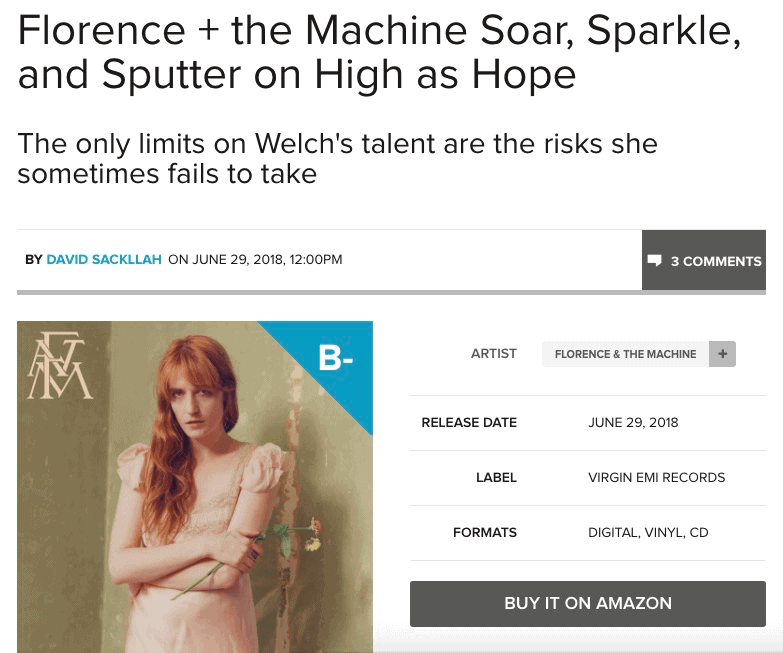
We love how this review provides a visual summary of key information at the beginning.
The title indicates that the album could have been better, and the prominent “B-” on the album cover makes the overall rating clear.
You could do the same for your blog using a letter grade or number system.
Reading on, however, you learn more about the reason for this rating.
The review is split into four parts:
- The Lowdown — Provides context and an overview of the album.
- The Good — Explores what the reviewer liked about the album.
- The Bad — Examines what could have been better.
- The Verdict — Answers the overall question “Should I listen to this album?”
- Essential Tracks — Points the reader to the tracks that are worth listening to first.
You don’t have to use a format like this for your post, but a good review will include all of the above information.